Code and surface
Confirm symbol size, contrast, quiet zone, curvature, reflectivity, damage and whether the mark is printed or direct-part-marked.
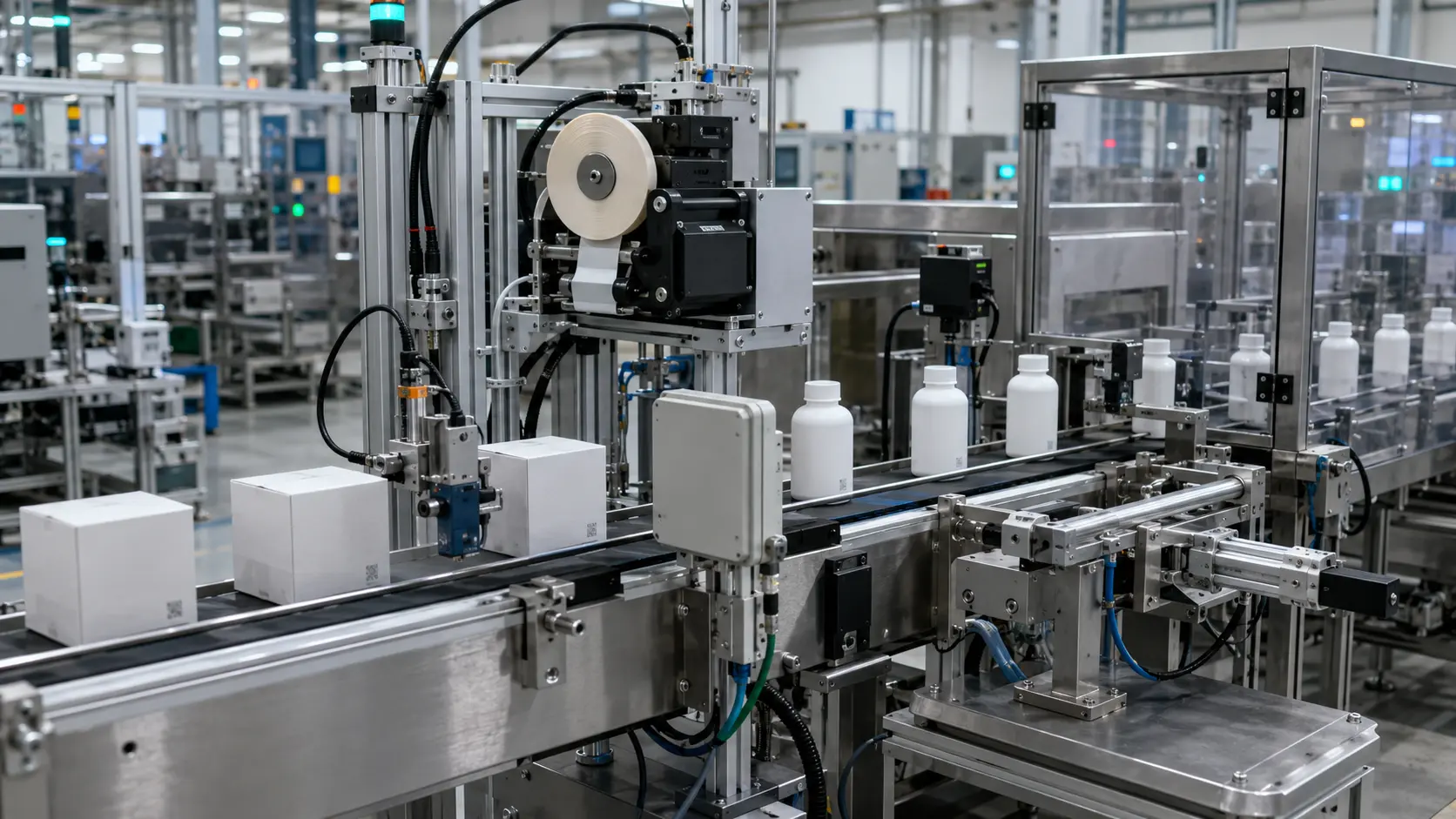
Select, position and integrate fixed-mount, handheld and DPM readers around the code, product movement, lighting and line response.
Industrial barcode scanners read 1D barcodes, QR codes, Data Matrix symbols and direct part marks at production speed. A complete application also controls lighting, distance, product presentation, communications and the action taken after each read.
Oxford Traceability develops the read point around representative products and failure modes. The system can validate expected data, prevent duplicate or wrong-product processing, exchange results with a PLC or database and retain the event needed for traceability.
Decode performance depends on more than the scanner model. These four decisions normally define the reliable solution.
Confirm symbol size, contrast, quiet zone, curvature, reflectivity, damage and whether the mark is printed or direct-part-marked.
Control distance, angle, orientation, speed, vibration and the number of possible code positions.
Use the field of view, focal distance, illumination and filters that reveal the code without glare or motion blur.
Define no-read, wrong-code, duplicate, rework, reject and recovery behaviour before commissioning.
A sample-led process reduces the risk of choosing hardware that decodes on a bench but fails in production.
Include good, marginal and failed codes plus the real range of surfaces, positions and production speeds.
Establish scanner, lens, light, distance and exposure settings against measurable acceptance criteria.
Connect triggers, validation rules, PLC handshakes, databases, reject devices and operator prompts.
Test no-read, multiple-read, wrong-code, network loss, stopped-line and restart behaviour.
Practical answers to common buying and implementation questions.
A scanner decodes data under its operating conditions. A verifier grades symbol quality using a controlled method and applicable standard. Many projects need production scanning; regulated or customer-specified applications may also need verification.
Yes, when the selected reader, optics, lighting and code presentation suit the application. DPM codes often need specialist illumination and controlled part orientation.
Yes. The scanner result can be validated by a PLC or software layer and used to interlock a process, operate a reject device, prompt an operator or retain a traceability event.
Yes. Integration can use the reader interface, PLC, industrial network, middleware or a database service, depending on the required data flow and response time.
Send code samples, product images, line speed and the action required after each read. We will define the most useful trial and integration route.